How to prepare for the new rules on payment acceptance: Slovakia is switching to the new system from the beginning of 2026
In Slovakia, a new law on revenue registration was approved in 2025, which fundamentally changes the rules of payment from the beginning of 2026.
How does it work?
The entrepreneur can choose the form of payment acceptance: payment terminal or QR payment.
QR payment is a state-backed, cheaper alternative to terminals and works on the basis of instant bank transfers:
The cash register generates a dynamic QR code
the customer scans it in the mobile banking app
IBAN, amount and variable symbol are automatically pre-populated
after confirmation, the payment is in the merchant's account within a few seconds
the new Instant Payment Notifier (NOP) system pairs the payment with the cash register and displays "Payment Received"
How can I view the QR code for a payment?
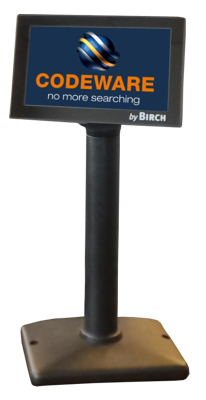
CODEWARE has prepared for this law and offers displays that show a QR code generated from the information system.
A suitable solution is the PD500 display, which can display any image and QR codes:
the customer receives the QR code on the PD500 display and, after scanning it, makes payment via mobile phone
the receipt can be printed via CV2-UN or CP-Q5 printers
CODEWARE offers a wide selection of receipt printers, you can also use the mobile BT printer BM-iC3.
Fines
Penalties of between €500 and €15,000 can be imposed for non-compliance .
Recommendation
Take advantage of the possibility of purchasing these funds for QR payment. The PD500 display meets all the key requirements for displaying QR codes. The only requirement is that the POS software is able to generate and send the QR code as an image to the display. In addition, the displays can also be used to display advertising.
Contact the CODEWARE team - we will be happy to prepare a suitable configuration for you. Get in touch with our purchasing department or fill in the contact form.
Hardware requirements for QR payments
PD500 features
Colour display with the ability to display graphics (bitmap)
Yes - TFT-LCD, supports images (logo, advertisements, QR code)
Sufficient resolution for QR code readability (min. 320 × 240 px)
800 × 480 px (excellent for QR code)
Sufficient brightness for visibility in a sales environment (min. 300 nits)
approx. 450 nits (good readability)
Display size min. 4" for comfortable scanning
5" diagonal
Fast content update capability (dynamic QR code)
Yes - via USB/RS232, compatible with ESC/POS protocols
Compatible with POS system (standard interface)
USB, RS232, ESC/POS support
Stable mounting and visibility for the customer
Yes - on the rack
FAQ - Frequently asked questions about the new law on sales records
The new law introduces the possibility to accept payments in two ways - via a payment terminal or via QR payment. The aim is to simplify and speed up payments and ensure their automatic matching in the NOP system.
All retailers and service providers who accept payments outside of online payment gateways - i.e. brick-and-mortar outlets, on-site payment service providers, showrooms and dispensing points. However, the QR principle can also help e-shops, for example when paying an invoice or order.
NOP is a government system that automatically pairs a customer's immediate payment with a business's cash register. As soon as the payment is received, the cash register displays a "Payment Received" message.
QR payments are fast, easy and significantly cheaper than card transactions - they do not require bank fees for card gateways and terminals. They work through instant bank transfers that are credited within seconds. QR payments also minimise data entry errors as all information (IBAN, amount, variable symbol) is automatically filled in when the QR code is scanned.
To display QR codes, you need a display or device that can receive images from the POS software and display them in sufficient resolution. Most often, these are custom displays like the PD500, which allow for fast redrawing of the dynamic QR code and reliable readability for the customer. Proper connection to the POS system (USB, RS232) and support for standard protocols such as ESC/POS are also important.